Sustainable Food Packaging with 30% PCR Resin: A Customer Success Story
3
min read
July 22, 2026
Many businesses have sustainability goals, but Walmart's Project Gigaton has been especially aspirational. In 2017, the company announced an initiative to reduce one billion metric tons of greenhouse gas emissions across its global supply chain by 2030.
Since then, Walmart has expanded its efforts with a goal of achieving zero operational emissions by 2040 while launching multiple initiatives to reduce food and packaging waste.
The Challenge
Walmart's sustainability ambitions required packaging solutions that were not only environmentally responsible but also economically practical. While sustainable packaging options already existed, many carried a significant cost premium.
The challenge called for a smarter, scalable solution.
Imperial Brady's Chris Lee had built a long-standing relationship with Emerald Packaging, a recognized leader in sustainable food packaging solutions. Through that partnership, Chris identified an opportunity to connect Emerald Packaging with Wada Farms, a supplier of Walmart's root vegetables, creating a collaboration that aligned Emerald's packaging expertise with Walmart's sustainability initiatives.
Emerald Packaging had already developed a food-grade package containing 30% post-consumer recycled (PCR) resin for other produce applications. Potatoes, however, introduced a unique challenge.
The new package would require significantly greater impact strength, puncture resistance, and heat seal integrity to withstand packing, palletizing, shipping, and retail distribution.
The Solution
Recognizing the opportunity, Chris introduced the concept to Wada Farms, who presented it to Walmart.
Emerald Packaging had recently developed an innovative low-density polyethylene (LDPE) film utilizing FDA-approved post-consumer recycled (PCR) resin suitable for direct food contact. The technology was production-ready—it simply needed to be engineered to withstand the demanding conditions of potato packaging.
The packaging had to survive the equivalent of 500 pounds of impact force, created by ten-pound bags of potatoes dropping approximately five feet during the filling process.
After extensive formulation testing and refinement, the team successfully developed a potato bag containing 30% FDA-approved PCR resin that met both performance and sustainability objectives.
Equally important, Wada Farms was able to run the new packaging on its existing high-speed wicketed bagging equipment—processing approximately 250 pounds of potatoes per minute—without modifying equipment or sacrificing production efficiency.
Customer Perspective
"We're thrilled to partner with Walmart to bring our PCR expertise to potato packaging. Every lot of resin and every roll of film is carefully tested from the lab to the line—because doing it right matters both for performance and the environment."
Kevin Kelly
President & CEO, Emerald Packaging
Results & Impact
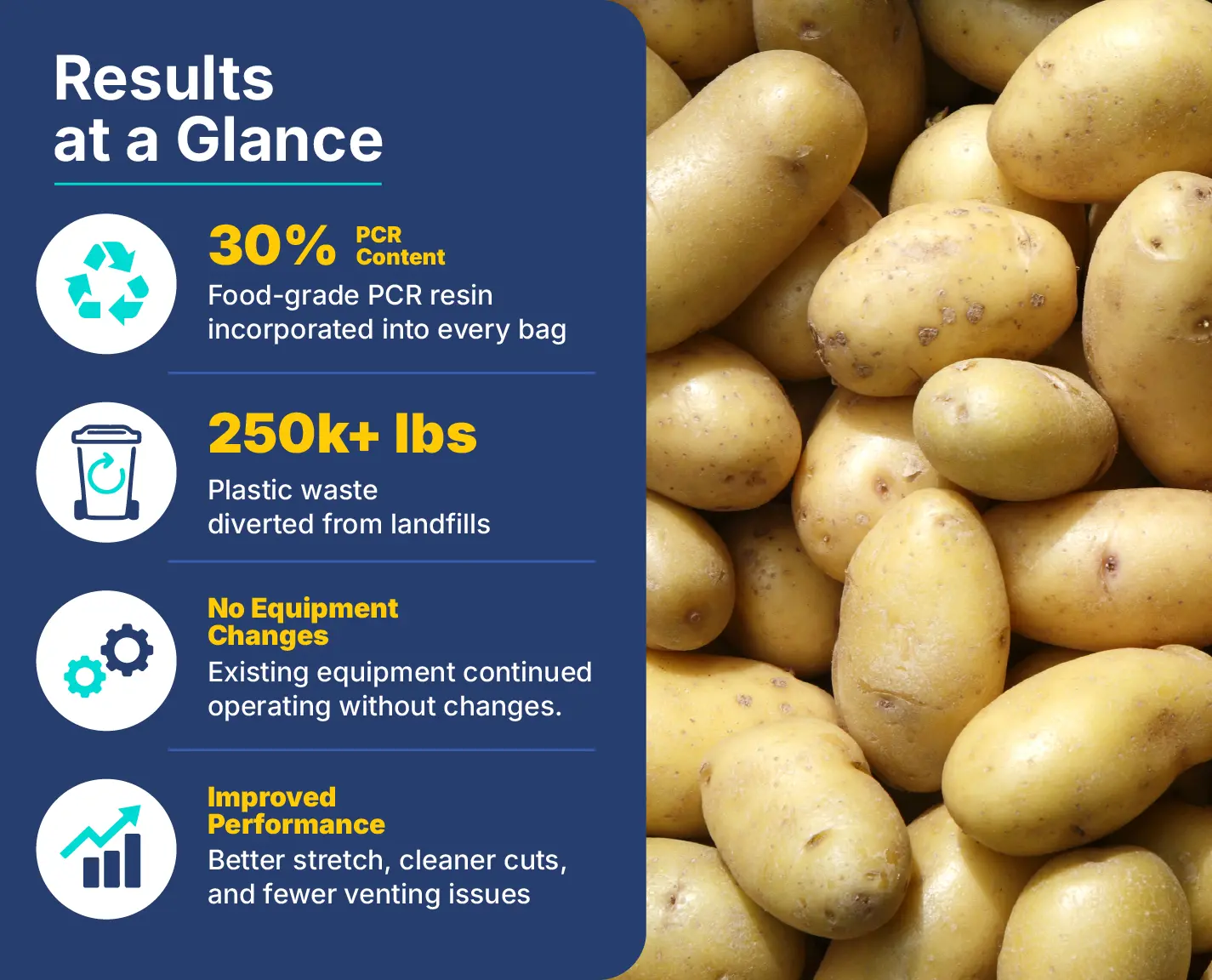
The transition to PCR resin delivered measurable environmental and operational benefits.
- Bags now contain 30% post-consumer recycled (PCR) content
- Virgin resin usage decreased to 12.6 lbs/M
- An estimated 250,000 pounds of plastic waste have been diverted from landfills since the program began
Perhaps most importantly, manufacturers were able to achieve these sustainability improvements without disrupting production.
The existing bagging equipment required no modifications, and the new PCR bags actually demonstrated improved performance over traditional polyethylene by reducing venting issues, improving stretch characteristics, and delivering more consistent cuts.
From a manufacturing standpoint, the solution also maintained compatibility with existing extrusion, printing, and converting processes, eliminating the need for specialized equipment or significant capital investments.
Strategic Considerations
As Extended Producer Responsibility (EPR) regulations continue to evolve, manufacturers are increasingly evaluating packaging through both an environmental and financial lens.
Emerald Packaging is already preparing for California's EPR requirements, where packaging containing 20% or more PCR content may qualify for substantially reduced regulatory fees. Oregon has introduced similar incentives.
While PCR resin currently carries a higher material cost than virgin resin, growing retailer expectations, regulatory changes, and continued manufacturing advancements are steadily improving its long-term business value.
Organizations that begin incorporating recycled-content packaging today will be better positioned to meet tomorrow's sustainability requirements while strengthening relationships with environmentally focused customers and retailers.
Looking Ahead
This collaboration has strengthened customer relationships while creating opportunities to expand recycled-content packaging into additional commodity categories.
As sustainability initiatives continue to accelerate across manufacturing and retail, PCR resin is proving that environmentally responsible packaging doesn't have to compromise performance. It offers a practical, scalable solution that helps businesses reduce waste while maintaining operational efficiency.


